Are you considering using electronic medication administration records in your care service? An increasing number of care providers are choosing to digitise their medication records.
An electronic medication administration record (eMAR) can help you avoid dangerous medication errors, keep confidential documents secure, reduce the time that your care workers spend on paperwork, and make it easier to audit your records.
In this article, we’ll look at what electronic medication administration records are, and how they’re an improvement on traditional paper records. We’ll share our top 10 reasons to consider using an electronic medication administration record in the UK.
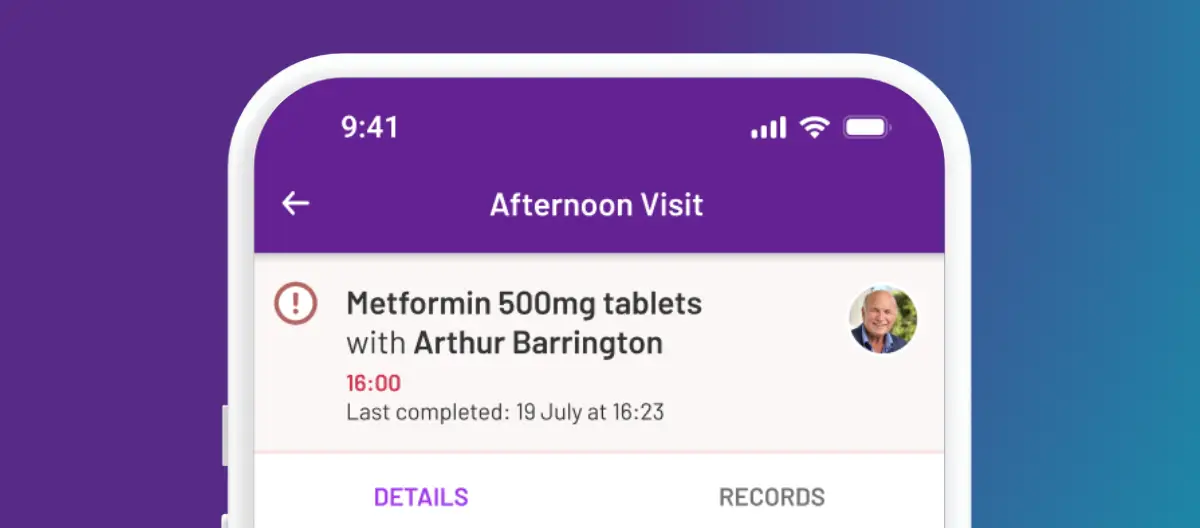
Table of Contents
What are medication administration records?
Medication administration records, or MAR charts, are used to record when a care worker has administered medication to a client. A medication administration record is a legal document, and it’s an important part of keeping clients safe.
A carer should check the medication administration record before supporting a client to take medication. This routine check reduces the risk of dangerous medication errors.
If errors do happen, accurate medication administration records help you see what has happened – and can take action quickly.
Depending on your organisation’s policies, your medication administration records might be pre-printed MAR charts, or electronic MAR systems. If you support a client with their medication, you should record it every time on a paper MAR sheet or an electronic medication administration record.
Medication administration records can help prevent fatal medication errors. If you don’t understand your organisation’s medication systems, talk to a supervisor or colleague immediately.
See how our eMAR system helps teams stay on track, spot changes early, and deliver care that reflects real needs. Book a tour today.
What are electronic medication administration records?
An electronic medication administration record, or eMAR, is a digital system for logging medication.
They have replaced paper medication administration forms in many residential facilities and domiciliary care organisations.
eMAR systems are often included in care management software, like PASS. A care manager or co-ordinator will set up a client’s electronic medication record, similarly to how they would set up a paper log.
The medication administration record can then be accessed from a phone or tablet, so that carers can complete them during their care visit.
10 reasons to consider electronic medication administration records
Paper medication records are particularly cost-effective, but care providers are increasingly moving towards using electronic medication administration records.
eMAR systems have a range of advantages – they’re quick and easy to fill out, allow you to keep medication records secure and confidential, and can even give you reminders and alerts if needed.
Here’s just 10 reasons to use an electronic medication administration record:
- Increased compliance
- Ease of access
- Ease of storage
- No need to worry about reading handwriting
- Increased security
- Automated reminders and alerts
- Real-time updates for increased efficiency
- Ease of auditing
- Better co-ordination with colleagues and other healthcare professionals
- Easy to share with CQC inspectors
Let’s look at these benefits of using electronic medication administration records in more detail.
1. Increased compliance
One of the biggest electronic medication administration record benefits is increased compliance.
When carers fill in a paper medication administration record, they may leave sections blank, or use non-standard abbreviations.
There are lots of reasons for this – perhaps they’re rushing to finish the visit and get to another client, they’ve temporarily forgotten an abbreviation, or they’re distracted by the client’s other needs.
A digital system forces the carer to complete the electronic medication administration record fully.
A choice of appropriate responses ensure that care workers follow standard procedures when logging medication. It also makes it quicker – time, date, carer’s information and other details are already populated, so there’s less for the support worker to do.
2. Ease of access
An electronic medication administration record, or eMAR, can be accessed anywhere, as long as the carer has the software installed on their phone, tablet, or computer.
You may have questions about a client’s medication management when you’re not near their paper records. Using an eMAR system, you can log in anywhere to check their details.
3. Ease of storage
You should keep all medication records for at least eight years after the client stops receiving care from your service.
So, if you support lots of clients with complex health conditions, you might struggle to find space to store those paper medication administration records. Most care providers are familiar with the rows of filing cabinets in care offices!
However, electronic medication administration records can solve this problem. They’re stored securely on a server, freeing up space in the office.
Storage space in care offices is often at a premium – and medication administration records aren’t the only problem.
If you’re struggling to find somewhere to securely store care plans, risk assessments, and other confidential documents, consider using care planning software. Client information can be safely stored and accessed by authorised individuals, without needing the extra physical space.
4. No need to worry about reading handwriting
Have you ever struggled to read someone’s care notes? Perhaps one of your care team has very messy handwriting, their pen was running out, or they were rushing while filling in a form.
Many clients receive care from multiple people, including family members and paid support workers. These carers all rely on notes from the previous care visit to report any issues.
If your clients’ medication records are illegible, they’re at risk of serious medication errors. For example, if you can’t tell whether a client has taken their last pill, you might administer it to them again – but, what if they’ve now had a double dose?
With electronic medication administration records, you don’t need to worry about messy handwriting. You should be able to read everything easily, and understand your client’s needs.
5. Increased security
When you use paper documentation, there’s always a risk that it could fall into the hands of the wrong person.
Whether you leave care information in a client’s room or carry it to and from the care office, it could easily be lost or intercepted.
With care management software and electronic medication administration records, client’s personal information is kept confidential – even if someone else finds a carer’s phone, tablet, or computer.
Authorised care workers must log in to a secure system to access care plans, medication records, and other personal information.
6. Automated reminders and alerts
Two of the most common medication errors are missed doses and giving the wrong dosage – or the wrong medication entirely.
It’s not always easy to spot this with paper records, but eMAR systems can help care workers avoid these issues with automated reminders and alerts.
Electronic medication administration records can alert carers if a dose hasn’t been recorded, reminding them to give the medication and log it.
Additionally, if a carer tries to record the wrong dosage or medication, the system can alert them to the problem – allowing them to catch medication errors early, and take action to keep the client healthy.
Automated reminders and alerts can also help care workers stay aware of a client’s allergies or previous reactions, and any other contraindicated medications.
7. Real-time updates for increased efficiency
As soon as someone has administered medication, an eMAR system should update – and the client’s entire care team can see the entry.
Unlike paper charts, which can only be viewed in one place at one time, everyone can access these real-time updates to an electronic medication administration record.
And, if a client’s health situation or care plan changes, care management software can immediately update the care team.
8. Ease of auditing
eMAR systems can increase compliance, but care managers and supervisors will still need to audit medication logs.
Whether you’re auditing client files so that you’re ready for a CQC inspection, or you’re checking a client’s progress ahead of a care plan review, electronic medication administration records can make this easier.
You can easily see any concerns, such as refused dosages, adverse reactions, or an increase in the use of pain or anti-nausea medication.
If there are medication errors, you can also keep track of which staff member was involved. Unlike paper medication records, where carers need to manually sign their name or initials, electronic medication administration records automatically fill in the care worker’s details – so you can easily spot if a team member needs extra training.
9. Better co-ordination with colleagues and other healthcare professionals
A good electronic medication administration record can help support workers communicate with each other, as well as with other healthcare professionals, such as GPs.
The PASS system includes GP Connect, which allows authorised staff members to access a client’s medical records – saving time for everyone, and ensuring that support workers have the information they need to deliver great care.
For example, if you’re planning care or setting up a service user’s electronic medication administration record, you can easily access a list of their known allergies and adverse reactions.
Regular communication between care workers can be hugely important. Sharing information about a client’s physical and mental health, as well as key events in their life, can help a support team approach them sensitively and provide great person-centred care.
If you’re a domiciliary care provider, your staff team may rarely meet. If your clients receive care from more than one support worker, it can be particularly challenging to ensure that they can communicate easily.
Home care software can be a huge help here, giving care workers the chance to see real-time notes about their clients, and even letting them contact each other and the client’s authorised family and friends when necessary.
10. Easy to share with CQC inspectors
CQC inspectors will ask to see your medication records, along with other key documentation, such as care plans and risk assessments.
A good electronic medication administration record will be easy to share with the inspectors, either via a phone, tablet, or computer, or as a print-out.
Considerations before moving to electronic medication administration records (eMAR)
As we’ve seen, there are lots of electronic medication administration record benefits, and it could be a good solution for your care service.
However, before you switch to an eMAR system, you need to make sure that your organisation is set up to use digital medication records.
Ask yourself these questions:
- Do all of our care staff have access to a phone or tablet that can run this software, or will we need to provide one?
- What extra training will we need to give our staff team?
- When we use bank or agency staff, how will we bring them up to speed with our system?
- Do we need to make changes to our medication policies and procedures to include the new system?
Conclusion: Electronic medication administration records
Medication administration records reduce the risk of dangerous medication errors, and digital systems can improve this safety further.
With eMAR, or electronic medication administration records, your care workers can fill in medication logs efficiently, increasing your organisation’s compliance.
There’s no risk of misreading messy handwriting, or non-standard abbreviations. Clients’ personal data is kept safe and secure, and paperwork and auditing becomes much quicker – giving you and your team more time to spend delivering high-quality care.